Every chimney fire has the same fuel source. Understanding how it forms tells you exactly how to prevent it.
How creosote happens
Wood smoke is full of unburned volatile compounds. When smoke hits a flue wall cooler than about 250°F, those compounds condense on it — the same way breath fogs a cold window. That residue is creosote, and it is roughly as flammable as the wood it came from.
Three things drive it: wet wood (energy goes to boiling water instead of burning gases), slow smoldering fires (cooler smoke condenses more), and an oversized or exterior flue (more surface area, colder walls).
Stage 1 — dusty and harmless
Light, flaky, soot-like. Brushes off easily. This is what a properly burning fire in a properly sized flue produces, and it is what a routine annual sweep removes in an hour.
Stage 2 — crunchy and building
Hard black flakes with a texture like cornflakes, often with a shiny edge. Requires more aggressive brushing and sometimes rotary tools. At this stage you have a meaningful fire load and you have probably skipped a season or two, or you are burning wood that is not seasoned.
Stage 3 — glazed, and the dangerous one
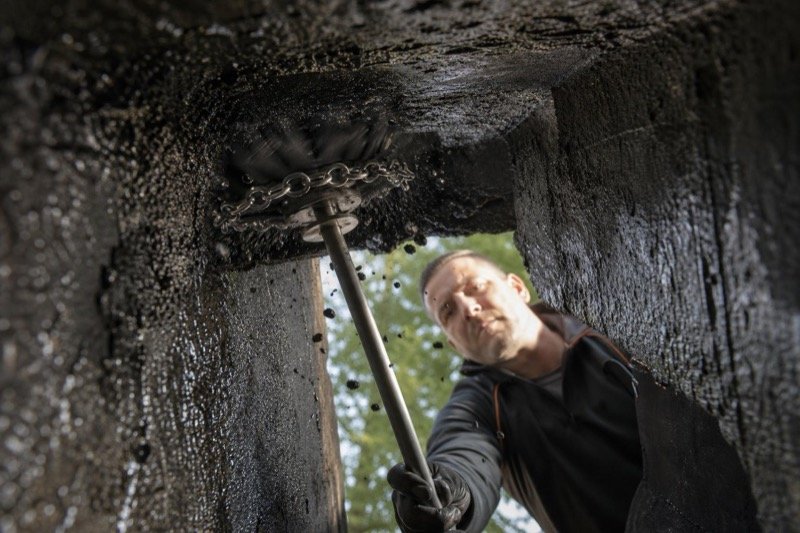
Shiny, tar-like, hard as glass, often running down the flue wall in drips. This is concentrated fuel welded to your liner. A standard brush slides right over it.
Removal requires rotary chain or whip systems and usually a professional catalytic modifier that makes the glaze brittle first — that is what our creosote removal service is for. It costs more than a sweep because it is a fundamentally different job.
What a chimney fire actually does
A creosote fire can exceed 2,000°F. Clay flue tiles crack under that kind of thermal shock. Once the liner is compromised, the next ordinary fire has a path to the wood framing around the chimney — which is how a chimney fire in January becomes a house fire in March.
Many chimney fires are never noticed. If you see puffy or honeycombed creosote, a warped damper, cracked flue tiles, discolored roofing near the chimney, or creosote flakes on the roof, you likely had one.
Prevention, in order of effectiveness
- Burn seasoned wood only — under 20% moisture, split and stacked at least six months, ideally a year. A $25 moisture meter settles every argument.
- Burn hot, not slow. Smoldering an airtight stove down overnight is the single biggest creosote generator there is.
- Get the flue sized right. An oversized flue cools smoke too fast. This is often solved by relining to the correct diameter.
- Sweep annually. Stage 1 never becomes stage 3 if it is removed every year.
About those chimney sweeping logs
They contain additives that can dry out stage-2 creosote and make it flake somewhat. They do not remove anything — the debris still has to come out of the flue — and they have essentially no effect on stage-3 glaze. Fine as a supplement. Never a substitute.
Want us to take a look?
Free estimates across all 97 towns we serve. We will tell you honestly if nothing needs doing.