Chimney questions,
answered straight.
No jargon, no scare tactics. If your question is not here, call us — we like this stuff.
How often should my chimney be swept?
NFPA 211 calls for an annual inspection of every chimney, fireplace and vent, with sweeping and repair as needed. For a wood-burning fireplace used through the season, that means a yearly sweep. Gas fireplaces and furnace flues produce no visible soot but still need the annual inspection — their failures are quieter and more dangerous.
What happens during a chimney sweep?
We lay drop cloths, seal the fireplace opening and connect a HEPA-filtered vacuum. Then we brush the flue, smoke chamber, smoke shelf and firebox with rotary and poly brushes sized to your flue, working the debris into the vacuum. Afterward we run a Level 1 inspection, photograph anything notable, and email you the report.
How do I know if I have a chimney problem?
The common signals: smoke entering the room, a strong campfire or tar smell, visible shiny black buildup above the damper, water stains near the chimney, masonry debris in the gutters, white chalky staining outside, or animal noises in the flue. Any of those is worth a call.
What is creosote and why does it matter?
Creosote is condensed wood smoke — and it is fuel. It builds in three stages, from a light dust to a hard, shiny glaze. Stage three burns at temperatures that crack liners and set houses on fire, and it cannot be removed with a standard brush. Annual sweeping prevents it from ever reaching that stage.
What is the difference between Level 1, 2 and 3 inspections?
Level 1 is the annual check of readily accessible parts on an unchanged system. Level 2 adds video scanning of the flue plus attic and crawlspace access, and is required for home sales, fuel or appliance changes, and after a chimney fire or storm. Level 3 involves opening up concealed areas and is only used when a serious hidden hazard is suspected.
Do gas fireplaces need to be cleaned?
Yes — annually. Pilot assemblies foul, thermocouples fail, log placement drifts and vents get blocked by nests. Because there is no soot and no smoke, gas problems are invisible until they become carbon monoxide problems.
Why does smoke come into my room?
Usually one of four causes: the flue is the wrong size for the fireplace opening, the smoke chamber is rough and unparged, the damper is not opening fully, or the house is too airtight and the fire cannot get makeup air. Each has a different fix, which is why diagnosis matters more than the repair.
How long does a chimney liner last?
Clay tile liners typically last 30 to 50 years but crack from heat shock and settling. A quality stainless steel liner, properly sized and swept annually, is generally a lifetime component and usually carries a lifetime warranty for the original homeowner.
Is my chimney leak actually the chimney?
Nine times out of ten the water is coming in at the flashing or the crown, not through the flue. That is why we inspect the whole top of the system before recommending anything — sealing brick that was not leaking solves nothing.
Do I need a chimney cap?
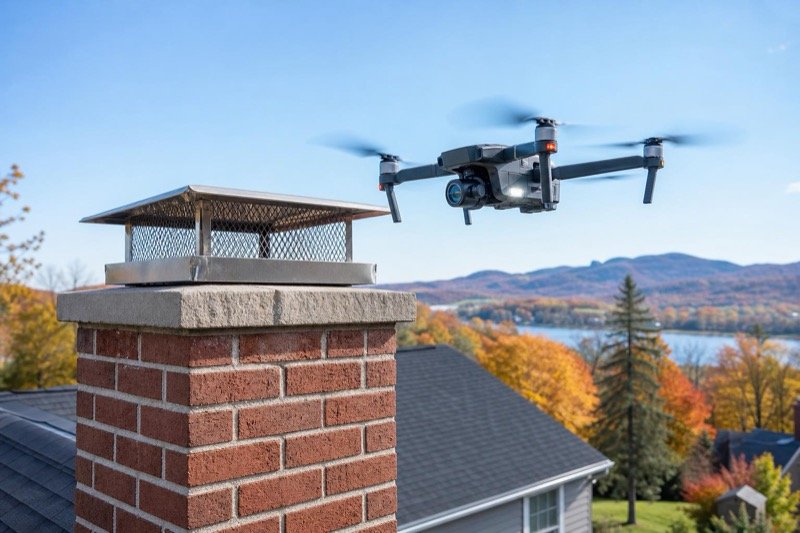
It is the highest-value item on the entire chimney. It keeps rain, snow, leaves, birds and squirrels out of the flue, and keeps embers off your roof. A few hundred dollars prevents thousands in water damage and animal cleanouts.
Can I sweep my own chimney?
You can buy a brush kit, and for a light-use flue you can remove some soot. What you cannot do is inspect what you just cleaned, identify a cracked tile or a failing liner, or safely handle stage-three creosote. Most homeowner sweeps miss the smoke chamber entirely, which is where buildup concentrates.
How much does chimney work cost?
Sweeps run $189 to $349, inspections $149 to $499, crown repair $450 to $1,600, relining $2,200 to $4,800, and rebuilds from about $2,500. See our full pricing page for every service.
Do you serve my town?
We cover 30 miles around Monsey — 97 towns across Rockland, Orange, Westchester, Bergen and Passaic Counties. Check the service area page for your town, or just call and ask.
What should I do after a chimney fire?
Get everyone out, call 911, and do not use the fireplace again until it is inspected. Chimney fires reach temperatures that crack flue tiles and damage liners even when the outside of the chimney looks untouched. A Level 2 inspection tells you what actually needs replacing.
Are you licensed and insured?
Yes — fully licensed and insured with liability and workers' compensation coverage. We send certificates directly to HOAs, property managers, insurers and attorneys on request.
When is the best time of year to book?
Spring and summer, without question. Everyone calls the week the weather turns, so October through December means longer waits everywhere. The work is identical in June and it is far easier to get the date you want.

Still have a question?
Call or text us — we answer chimney questions all day long, free of charge.